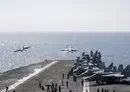
![A US Air Force A-10 Thunderbolt II aircraft flies over the US Central Command area of responsibility during Operation Epic Fury, March 9, 2026. [US Air Force]](/ssc/images/2026/03/28/55143-_91f__a-10_thunderbolt_ii-600_384.webp)
The A-10 Thunderbolt II, commonly known as the "Warthog," has earned its reputation as a battlefield workhorse.
Built for close air support and renowned for its tremendous survivability, the aircraft has been a key instrument in American combat operations for decades.
Most recently, its performance during Operation Epic Fury confirmed its status as one of the US military's most vital assets.
The A-10 operated tirelessly in one of the largest deployments of American airpower in recent history, targeting the Iranian forces with precision and relentless firepower.
The mission established the "Warthog" as the informal "Shahed Killer," a name derived from its ability to neutralize the regime's Shahed drones with exceptional efficiency.
Adapting to the modern battlefield
The A-10's role during Operation Epic Fury demonstrated how it continues to adapt to the challenges of modern warfare.
Its ability to loiter over contested battlefields for more than two hours allowed it to engage time-sensitive targets, including Shahed drones and hardened positions.
The aircraft's integration with Advanced Precision Kill Weapon System (APKWS) rockets gives it a cutting-edge, confirming its effectiveness against Iranian drones deployed in recent conflicts.
This performance isn't new for the A-10, but Operation Epic Fury showcased its unique strength.
While advanced aircraft like the F-35 or B-2 bring speed and stealth, none can sustain the kind of persistent presence offered by the Warthog.
Its role in neutralizing critical threats and supporting ground forces in complex, high-stakes operations defines its irreplaceable value, particularly against modern drone warfare.
During Operation Epic Fury, the Shaheds became a critical threat, and the A-10 earned its nickname by showcasing unparalleled lethality, resilience, and adaptability in combat.
A weapon built for the fight
No aircraft in the US arsenal matches the A-10's design for close air support.
Engineered specifically to dominate, the Warthog carries an arsenal that includes AGM-65 Maverick missiles, laser-guided bombs and APKWS rockets, with 16,000 pounds of payload capacity.
Its core weapon, the GAU-8/A Avenger, is a seven-barrel 30 mm Gatling cannon capable of firing 4,200 rounds per minute.
During Operation Epic Fury, this weaponry was instrumental in targeting and neutralizing fortified Iranian positions and other high-value threats.
Unlike high-speed aircraft that rely on their speed and altitude to evade threats, the Warthog was built to take hits and keep flying.
Its 1,200-pound titanium "bathtub" cockpit protects its pilot from cannon fire up to 23 mm, allowing it to sustain damage and still return to base.
This ruggedness was proven in the Gulf War, where the A-10 destroyed 1,500 tanks, 2,000 vehicles and artillery while losing only six aircraft.
The A-10's legacy is unmatched, having proven time and again its critical role in close air support missions.
From Desert Storm to Operation Hawkeye Strike in 2025, where the A-10 delivered over 100 precision munitions, liberating ISIS-controlled towns and proving indispensable in combat.
In the first 72 hours of Operation Epic Fury, A-10s struck over 1,700 targets, solidifying their dominance and the title of "Shahed Killer."