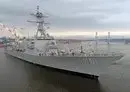
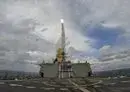
![A Standard Missile (SM-3) being launched from the Aegis Combat System equipped Arleigh Burke-class destroyer operating in the Pacific Ocean during a Missile Defense Agency ballistic missile flight test. [Ho/US Navy/AFP]](/ssc/images/2026/04/07/55290-_94c__arleigh_burke-class_firing-600_384.webp)
During Operation Epic Fury, the US Navy faced an intense threat after the Iranian regime's forces counterattacked with ballistic missiles and drone swarms.
Surface combatants in the Persian Gulf and Arabian Sea encountered waves of retaliation following strikes on key Iranian missile sites.
Despite the unprecedented threat, US Navy warships displayed tactical excellence through their integrated air and missile defense systems.
The majority of incoming threats were neutralized, demonstrating a coordinated, layered defense that cemented US dominance.
Layered defense proves its worth in Operation Epic Fury
The success of the operation rested on a comprehensive, multi-layered air and missile defense strategy.
Arleigh Burke-class destroyers used SM-3 Block IIA missiles to intercept Iranian ballistic missiles at high altitudes during their exo-atmospheric phase, far above Earth's atmosphere.
As missiles transitioned to their terminal phase, SM-6 interceptors engaged them midflight, eliminating threats before they could cause harm.
Fast-moving cruise missile threats were effectively neutralized by SM-6 interceptors, further highlighting their exceptional versatility and adaptability in complex combat scenarios.
At shorter ranges, the Navy deployed additional defensive systems, including Evolved Sea Sparrow Missiles and Phalanx Close-In Weapon Systems, to counter incoming threats effectively.
This coordinated system achieved a high interception rate, demonstrating the effectiveness of integrated air and missile defense.
The system was designed to eliminate the risk of failure at any one point, effectively protecting the fleet and validating the value of layered defense.
Aegis Combat System and the SM-6: Keys to victory
A major factor behind the Navy's triumph during Operation Epic Fury was the Aegis Combat System, which connected shipboard systems into a unified network.
Serving as the nerve center for the defense effort, Aegis processed data in real time using the advanced AN/SPY-6 radar.
This allowed ships to detect, track and target ballistic and cruise missile threats across vast distances.
By seamlessly coordinating which weapons to deploy and when, Aegis maximized both efficiency and effectiveness.
Among the Navy's cutting-edge arsenal, the SM-6 missile stood out as the standout performer.
Each missile brought flexibility with its ability to counter ballistic missiles, cruise missiles and even surface targets.
During one critical engagement, SM-6 missiles eliminated both a low-flying drone and a high-speed ballistic threat within minutes, underscoring their value.
With annual production of SM-6 missiles increasing to 300 following a contract extension, Pentagon planners see the weapon as indispensable in future naval operations.
Operation Epic Fury also highlighted the need for at-sea resupply and for advancements such as directed-energy weapons.
Systems such as the HELIOS laser provided cost-effective solutions to low-cost drone threats, pointing toward the Navy's evolving toolkit for modern warfare.
Epic Fury succeeded as a test of advanced technologies, readiness and coordinated defense efforts, firmly establishing the US Navy's air superiority over the Gulf region.



The article is good and useful.
Reply