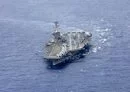
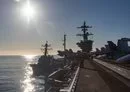
![An F/A-18F Super Hornet prepares to launch from the flight deck of the USS Abraham Lincoln (CVN 72) in the Arabian Sea, January 28, 2026. [US Navy]](/ssc/images/2026/02/14/54481-uss_abraham_lincoln-600_384.webp)
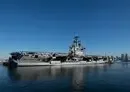
The USS Abraham Lincoln (CVN-72) is a Nimitz-class nuclear-powered aircraft carrier and among the largest warships in service.
Measuring about 333m in length, the ship displaces roughly 100,000 tons when at full capacity and can exceed 30 knots in speed.
The carrier is powered by two nuclear reactors that drive four main engines for sustained operations.
Commissioned in 1989, the Lincoln completed a modernization effort in 2017 which saw upgrades to its combat systems, flight deck and supporting infrastructure.
Its homeport is in San Diego, where it operates alongside four other carriers assigned to the Pacific Fleet.
The USS Abraham Lincoln contains medical and dental facilities, a post office, a television station, a library and retail services.
Its desalination systems produce up to 400,000 gallons of fresh water daily, ensuring a consistent supply for the entire crew.
At full complement, this provides roughly 70 gallons per person, a rate comparable to the average daily per capita usage in the United States.
Its base crew comprises about 3,200 sailors. When Carrier Air Wing 9 (CVW 9) is aboard, this number rises to 5,680.
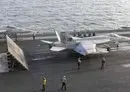
Spanning 4.5 acres, the massive flight deck enables the ship to embark and operate a diverse air wing of more than 85 aircraft.
The USS Abraham Lincoln stands out for its combination of both air and seapower.
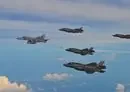
This versatile fleet includes advanced platforms including F-35C Lightning II, F/A-18E/F Super Hornets, EA-18G Growlers, E-2D Hawkeyes, CMV-22B Ospreys and MH-60R/S Sea Hawks.
Flight operations
The vessel has been deployed since November 2025, conducting flight operations and live-fire exercises in the South China Sea.
One of its centerpiece capabilities is its CVW 9, which features eight squadrons flying F-35C Lightning II.
In 2024, a US Marine squadron assigned to CVW 9 executed multiple strikes on Houthi weapons storage facilities, decimating stockpiles of anti-ship missiles and munitions.
These operations significantly neutralized threats to both military and civilian vessels attempting to traverse the Red Sea and Gulf of Aden.
When operating at peak tempo, the USS Abraham Lincoln can generate 240 sorties daily during a surge scenario.
Otherwise it can sustain a tempo over 120 sorties a day for thirty consecutive days.
Four of the Lincoln’s CVW squadrons are fighter units. The ship can launch about half of these combat aircraft within a 90-minute window.
This capability enables continuous cyclic launch and recovery operations, allowing the carrier to sustain a high strike tempo during intensive surge missions.
The strike power of the USS Abraham Lincoln adds to its immense deterrent capabilities.
Through self-sufficiency and a massive crew, the carrier can sustain multi-month deployments and project power far from US shores.