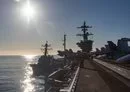
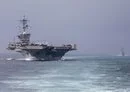
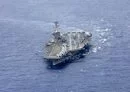
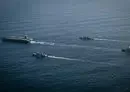
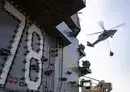
![The USS Abraham Lincoln (CVN-72) departs San Diego for deployment with Carrier Strike Group 3, including Carrier Air Wing 9, the cruiser USS Mobile Bay (CG 53) and Destroyer Squadron 21, on January 3, 2022. [Naval Air Forces]](/ssc/images/2026/02/18/54568-cvn_72-600_384.webp)
The Carrier Strike Group (CSG) Abraham Lincoln's Destroyer Squadron 21 is the centerpiece that directs and coordinates all surface combatants.
Operating from the USS Abraham Lincoln (CVN-72), DESRON-21 provides tactical command and control for destroyer operations in support of the carrier.
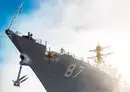
Three Flight IIA Arleigh-Burke class destroyers form the core of DESRON-21: USS Spruance (DDG-111), USS Michael Murphy (DDG-112), and USS Frank E. Petersen Jr. (DDG-121).
Spruance entered service in 2011, Michael Murphy in 2012 and Frank E. Petersen Jr. in 2022.
Each ship displaces approximately 9,200 tons when fully loaded and measures about 155m in length.
The Arleigh Burke Flight IIA destroyers are crewed by approximately 329 personnel, including officers and other sailors across multiple operational departments.
Multiple missions
DESRON-21 conducts an array of missions for CSG Abraham Lincoln. The ships can surround CVN-72 to conduct escort and ensure protection from multi domain threats.
For air defense, the destroyers use the Aegis Combat System and Standard Missiles to defend the carrier against aircraft and anti-ship missiles.
The Aegis system provides the ships remarkable sensors and combat systems, that help detect and target all manner of threats.
It uses AN/SPY-1 multifunction radar, a command and decision system (CDS), an Aegis display system and the weapon control system (WCS).
For ballistic missile defense, the ships can launch Standard Missile-3 interceptors to engage medium-range threats outside the atmosphere.
These systems feature Cooperative Engagement Capability (CEC), a sophisticated sensor-netting technology that enables the squadron to share real-time targeting data seamlessly across the network.
For subsurface threats, the AN/SQQ-89 sonar leverages active and passive sensors to ensure no threats from below go undetected.
Their anti-submarine warfare capabilities are critical to protecting the CSG Abraham Lincoln from subsurface threats.
The destroyers leverage hull-mounted and towed sonar, torpedoes and MH-60R Seahawk helicopters to detect and track submarines before they can approach the carrier.
To manage surface threats, the destroyers maintain the ability to track and engage hostile ships using missiles and ship-mounted guns.
For land attack, each destroyer can launch Tomahawk cruise missiles, prized for their standoff capabilities that allow the destroyers to strike land-based targets from faraway.
Additional destroyers
Each Arleigh Burke destroyer carries a 96-cell Mk 41 Vertical Launch System capable of launching Standard Missile-2, Standard Missile-3, Standard Missile-6 and Tomahawk cruise missiles.
The ships mount one 127-millimeter Mk 45 naval gun, two 25-millimeter chain guns and a Phalanx Close-In Weapon System for short-range defense.
DESRON-21 can add destroyers to the CSG Abraham Lincoln as needed.
Other Arleigh-Burke class ships already deployed in the Mediterranean Sea, Red Sea or Indian Ocean can be reassigned to the squadron.
Forward deployed destroyers in places such as Rota, Spain or Hawaii can be swiftly relocated to support DESRON-21.