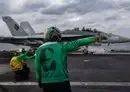
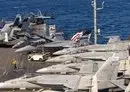
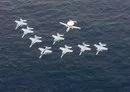
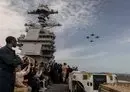
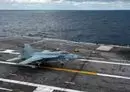
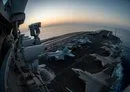
![Aircraft of Carrier Air Wing 9 (CVW-9) return to their home base of Naval Air Station Lemoore, on December 14, 2024, following a successful deployment aboard the USS Abraham Lincoln (CVN 72). The air wings operated throughout the US 5th and 7th Fleet areas of responsibility, supporting critical maritime security operations. [US Navy]](/ssc/images/2026/02/12/54511-carrier_air_wing_9_-600_384.webp)
Embarked aboard the super carrier USS Abraham Lincoln (CVN-72), Carrier Air Wing Nine (CVW-9), or "The Golden Eagles," represents the pinnacle of US naval aviation.
Comprised of nine squadrons and between 70 and 90 aircraft, CVW-9 integrates fifth-generation fighters and advanced electronic warfare to enable decisive carrier-based power projection.
CVW-9 is at the forefront of US naval aviation, representing one of the US Navy's most capable and combat-proven air wings.
In November 2024, CVW-9 became the first carrier air wing to employ the F-35C Lightning II in combat.
The aircraft conducted multiple strikes on Houthi weapons depots across Houthi- controlled territories in Yemen.
The F-35C's stealth profile enables deep penetration, and its advanced sensor capabilities ensure high accuracy.
These attributes directly corresponded to the air wing's ability to decimate Houthi targets and offensive strike capabilities.
In early February 2025, one of CVW-9's F-35Cs downed an Iranian Shahed drone that was harassing the USS Abe Lincoln in the Arabian Sea.
Electronic warfare capabilities
CVW-9 is the first and most experienced wing to employ the ALQ-249 Next Generation Jammer in combat.
This advanced system, integrated onto the EA-18G Growler, provides the fleet with elite electronic warfare capabilities.
The ALQ-249 pod integrates advanced hardware and software to disrupt adversary planning and execution.
This enhanced electronic warfare suite provides essential cover for strike aircraft during high-threat missions.
Structured to execute simultaneous missions, the Golden Eagles employs a blend of F-35Cs and F/A-18E Super Hornets for offensive strike.
Super Hornet can carry over 8,000kg of ordnance, including Joint Direct Attack Munition (JDAM), Joint Standoff Weapon (JSOW) and the AGM-84 Harpoon for maritime strike.
Together with the F-35C, the wing can conduct both high-stealth and volume precision attacks.
The F-35C's advanced sensor fusion pairs with the Super Hornet's AIM-120 and AIM-9X missiles to detect and neutralize aerial threats.
The EA-18G further augments these capabilities by providing jamming, electronic surveillance and targeting to degrade adversary radar and missile systems.
Middle East deployment
CVW-9's intelligence and surveillance center on the E-2D Advanced Hawkeye. Utilizing the APY-9 radar, it provides 360-degree, long-range detection of air and surface contacts.
CVW 9 rounds out its maritime domain awareness capabilities with MH-60R Seahawk helicopters.
The dextrous aircraft are essential for anti-submarine and anti-surface warfare, with their array of lightweight torpedoes, Hellfire missiles and sonobuoys that can detect undersea threats.
The Golden Eagle's record speaks for itself. During its six-month 2024 Middle East deployment, CVW-9 flew over 5,500 sorties totaling more than 11,000 flight hours.
This sustained operational tempo averaged approximately 30 sorties per day throughout the duration of the campaign.