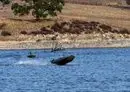
![An unmanned surface vehicle (USV) sails off the coast of Key West, Florida, during the annual Fleet Experimentation (FLEX) 2026 event, April 24, 2026. The exercise integrates commercially developed unmanned systems and AI with traditional manned naval platforms. [US Navy]](/ssc/images/2026/07/02/56785-_167__unmanned_drone_ship-600_384.webp)
Autonomous drone ships, operating in coordinated groups, are driving changes in naval operations and approaches to maritime security.
These systems utilize collective intelligence to address potential threats in maritime environments, operating before humans are involved in hazardous situations.
Transition to autonomous wolfpack operations
Naval organizations are transitioning from individually operated reconnaissance drones to networks of autonomous ships.
This framework is designed to address challenges such as state-sponsored naval disruptions, unmanned attack vehicles and fast-moving craft in strategic maritime areas.
Using groups of unmanned vessels may help maintain stability along international trade routes.
By shifting operations to a unified "wolfpack" of 10 to 15 unmanned vessels, commanders can easily secure volatile international trade routes.
Technological platforms rely on collective intelligence and are part of ongoing developments in how international coalitions approach regional challenges at sea.
Strategies for protecting navigation are evolving to meet changing and challenging conditions in contested waters.
Automated fleets create a defensive presence in areas with elevated risk, supporting safety while limiting direct exposure of personnel.
International shipping lanes experience unexpected incidents, prompting defense planners to consider autonomous maritime systems.
Integrated edge artificial intelligence (AI) enables these swarms to navigate busy shipping lanes and monitor cargo vessels.
The software detects visual and radar signatures that may indicate hostile activity, providing real-time awareness during maritime operations.
Kinetic defense and sea‑denial capabilities
For scenarios requiring active defense, the vessels are equipped with modular launch systems and precision munitions.
This configuration allows the swarm to respond to incoming threats with coordinated defensive actions.
For situations requiring deliberate kinetic sea‑denial, these vessels integrate modular launch cells with precision anti‑armor loitering munitions, enabling concentrated and highly effective engagement against threats.
The network serves as a tactical layer, addressing challenges before they reach crewed ships.
Technology supports navigation protection, with human operators maintaining oversight and control over engagement decisions in accordance with international protocols.
As maritime operations become increasingly complex, autonomous networks are intended to maintain continuity in global supply chains.
The pace and scope of adoption by naval forces will affect future strategies for safeguarding international commerce.
Allah willing, you'll win against Israel.
Reply