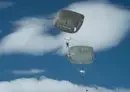
![Members of a Jedburgh team prepare for a nighttime parachute mission into occupied France during 1944. [National Archives]](/ssc/images/2026/07/22/57165-_200__jedburgh-600_384.webp)
The Second World War reshaped military thinking by proving unconventional operations could complement conventional campaigns against determined occupying forces.
Allied planners recognized that liberating Nazi-occupied Europe required close cooperation with resistance movements operating deep behind German front lines.
In 1943, the Office of Strategic Services, Britain's Special Operations Executive and Free French Bureau Central de Renseignements et d'Action jointly created the Jedburgh program.
The initiative produced small multinational teams capable of organizing resistance fighters, gathering intelligence, conducting sabotage and connecting local forces with Allied commanders.
Building an unconventional force
Each Jedburgh team normally consisted of three members, including British, American, French, Belgian or Dutch personnel, depending upon mission requirements.
Members completed rigorous instruction covering parachuting, demolitions, clandestine communications, weapons employment, guerrilla warfare and survival behind enemy lines.
Supreme Commander General Dwight D. Eisenhower approved the first operational insertions during the night preceding the Normandy landings on June 5-6, 1944.
Over the following three months, 93 Jedburgh teams parachuted into France, supporting resistance organizations throughout occupied territory.
Each team carried a portable "Jed Set" radio, enabling secure communication with Allied headquarters for intelligence reporting and supply coordination.
This communication capability allowed resistance leaders to request ammunition, explosives, medical supplies and additional personnel through coordinated aerial resupply operations.
The OSS and SOE supply organization at Area H prepared more than 3,335 tons of equipment, including approximately 75,000 small arms for airdrop.
Those deliveries helped arm roughly 300,000 resistance fighters before and after the Normandy invasion, dramatically expanding organized resistance capabilities.
Strengthening the French resistance
Jedburgh teams transformed scattered resistance groups into coordinated fighting organizations capable of supporting advancing Allied forces across occupied France.
Team FREDERICK parachuted into Brittany during June 1944, joining Team GEORGE and Special Air Service personnel supporting regional Maquis formations.
Together they coordinated supply drops, organized sabotage missions and disrupted German transportation networks supporting frontline operations after the Normandy invasion.
Team AMMONIA entered the Dordogne near Sarlat, linking rural resistance fighters with Allied logistics that sustained increasingly effective guerrilla operations.
Later that summer, Team CHLOROFORM organized Maquis forces throughout the Drôme, while Team BUGATTI operated near the Spanish frontier in the Hautes-Pyrénées.
Team BRUCE, led by future CIA Director William E. Colby, entered the Yonne during August 1944, disrupting German troop movements and communications.
These multinational advisory teams demonstrated that trusted local partnerships could produce operational effects far exceeding their small numbers and limited equipment.
Jedburgh-supported resistance compelled German commanders to divert valuable forces toward internal security rather than reinforcing frontline combat formations.
After the war, Colonel Aaron Bank carried Jedburgh lessons into the newly established 10th Special Forces Group, shaping modern unconventional warfare doctrine.
Today, US Central Command (CENTCOM) and its components continue studying historical innovations like the Jedburgh program, applying enduring lessons to future operational challenges.