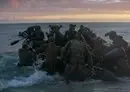
![US Marines with Company I, Battalion Landing Team 3/1, 31st Marine Expeditionary Unit, form a wedge formation during a simulated bilateral small boat raid at Kin Blue Training Area, Okinawa, Japan, February 26, 2026. [US Marine Corps]](/ssc/images/2026/03/25/55148-_93a__31st_meu-600_384.webp)
Operation Epic Fury entered another week of sustained strikes against Iranian forces, prompting the US to deploy the versatile Tripoli Amphibious Ready Group (ARG).
The ARG deployed the 31st Marine Expeditionary Unit (MEU) to project combat power ashore, marking a decisive escalation in Operation Epic Fury's campaign.
Positioning in the Persian Gulf and Gulf of Oman, this sea-based strike group proves critical in maintaining flexibility and dominance in a contested maritime environment.
The Tripoli Amphibious Ready Group
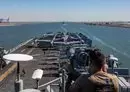
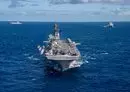
The Tripoli Amphibious Ready Group is built around three warships, each contributing unique capabilities to a self-contained strike and maneuver platform.
The USS Tripoli (LHA-7), an America-class amphibious assault ship, serves as the flagship, optimized for aviation operations with its expansive flight deck.
Supporting the Tripoli are the USS New Orleans (LPD-18) and USS Rushmore (LSD-47), one an amphibious transport dock and the other a dock landing ship.
Together, these vessels form a cohesive architecture for delivering Marines and equipment from ship to shore.
Integral to this system are the Landing Craft Air Cushion (LCAC) vehicles carried by the New Orleans and Rushmore.
These high-speed craft transport Amphibious Combat Vehicles (ACVs) and heavy equipment to beachheads at speeds exceeding 40 knots, ensuring rapid and efficient surface assaults.
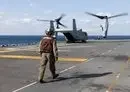
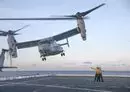
Complementing this capability, the USS Tripoli supports vertical assaults by launching MV-22B Ospreys and F-35Bs, creating a combined-arms force able to strike deep inland.
Ship-to-shore maneuvers and strategic reach
The 31st MEU's layered, multi-domain ship-to-shore assault approach is intended to provide flexible and lethal amphibious options for the US.
LCACs moves heavy equipment ashore, while MV-22B Ospreys rapidly inserts forces at 280 knots over 400 nautical miles, surpassing legacy helicopters.
This allows for deep envelopment of coastal objectives and maximum flexibility in targeting the Iranian regime's assets.
The integration of F-35B Lightning II aircraft brought fifth-generation stealth capabilities directly to the battlefield.
The F-35B's Short Takeoff and Vertical Landing (STOVL) capability allows it to launch from USS Tripoli without a catapult, providing close air support within minutes.
Exercises like Talisman Sabre 2025 validated this integration, showcasing the F-35B's ability to strike alongside amphibious forces during coastal operations.
The ARG's deployment mirrors historic operations, including the Inchon landings (1950) and the 2003 seizure of Iraq's Al-Faw Peninsula.
These amphibious assaults demonstrate how adaptable ship-to-shore operations remain relevant in contested environments.
Facing Iranian threats to Gulf shipping and the Strait of Hormuz, the Tripoli ARG offers flexibility for seizing chokepoints, securing islands or striking targets.
Embarking 2,200-2,500 Marines, the ARG represents a self-sustaining, rapid-response force built for modern amphibious warfare.
This strategic presence reinforces the deterrent value and operational readiness of America's forward-deployed forces in Operation Epic Fury's maritime theater.
I consider America to be the world's thug; it wages war on anyone who opposes its policies. It practices all kinds of violence in the world, and all wars in the world are sponsored by America.
ReplyI like it!
ReplyMay Allah grant victory to the resistance, Lebanon and the Arab nation! May He liberate Palestine from the accursed usurper and return land to its rightful owners! O, Lord, grant us an imminent victory, O, Lord!
Reply