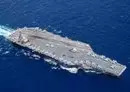
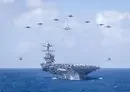
![Ford-class aircraft carrier USS Gerald R. Ford transits the Caribbean Sea during Carrier Air Wing 8's aerial change of command ceremony, January 19, 2026. [US Navy]](/ssc/images/2026/02/24/54720-_76a__uss_gerald_r_ford-600_384.webp)
The USS Gerald R. Ford is the lead ship of the Navy's newest class of nuclear-powered aircraft carriers.
Commissioned in July 2017, the warship represents the most technologically advanced carrier design ever fielded by the United States.
Displacing about 100,000 tons and stretching 1,106 feet in length, the carrier is slightly larger than Nimitz-class predecessors.
The ship is powered by two A1B nuclear reactors that generate roughly 25 percent more electrical power than earlier designs.
That increased capacity supports advanced systems, including electromagnetic launch equipment and future weapons technologies.
Thanks to advancements in automation, the carrier's crew of approximately 4,550 sailors and air wing personnel is more than 600 fewer than that of a Nimitz-class carrier.
Advanced systems drive operational tempo
The Ford-class incorporates several revolutionary technologies intended to boost efficiency and sortie generation rates.
The Electromagnetic Aircraft Launch System (EMALS) replaces traditional steam catapults with smoother, digitally controlled launches.
EMALS reduces stress on aircraft airframes and enables launches of a wider range of aircraft types.
The Advanced Arresting Gear system similarly modernizes aircraft recovery, improving reliability and reducing maintenance demands.
Three deck-edge aircraft elevators move planes between the hangar bay and flight deck without disrupting launch cycles.
Previous carriers relied on four centerline elevators that could interrupt flight operations during heavy use.
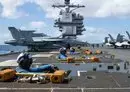
On-deck refueling stations positioned across the flight deck allow simultaneous refueling and rearming of aircraft.
Navy officials say these changes reduce turnaround time between sorties by up to 30 percent compared with earlier carriers.
The enhanced design allows the carrier to generate about 160 sorties per day during sustained operations.
Surge capacity can exceed 270 sorties daily during high-intensity combat scenarios, representing a significant increase over Nimitz-class ships.
Caribbean operations and global posture
The Ford recently completed operations in the Caribbean Sea in support of US Southern Command objectives.
The carrier conducted continuous flight operations, underscoring its ability to sustain elevated sortie rates.
Its presence in the region marked a significant commitment of naval power amid ongoing security concerns.
Carrier Strike Group Ford demonstrated coordinated operations with embarked air wing aircraft and supporting surface combatants.
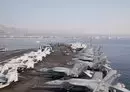
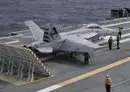
During those operations, F-35C Lightning II aircraft conducted strike missions while F/A-18E/F Super Hornets provided additional air support.
The carrier's integrated combat systems enabled seamless coordination across the strike group.
Early reports indicate the strike group is now en route to the Middle East.
The carrier's nuclear propulsion allows it to reposition rapidly without the need for frequent port visits.
Enhanced underway replenishment capabilities enable sustained high-tempo operations over extended periods.
The Ford's expanded electrical generation also supports future integration of directed energy weapons and next-generation radar systems.
Together, those advancements position the Ford-class to anchor US naval power projection for decades to come.
Empty talks and psychological warfare that neither nourishes nor satisfies hunger. No naval, air, or land force can defeat the Islamic Republic of ☪️Iran.
O Allah, grant victory to Islam☪️ and honor the Muslims☪️!
ReplyLong live Egypt! Long live Egypt! Long live Egypt and the Egyptians! Egypt is the mother of the world!
Reply