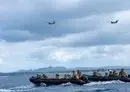
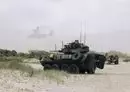
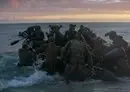
![US Marines with 2nd Assault Amphibian Battalion, 2nd Marine Division conduct pre-operation checks during Naval Integration Training Package 1 on Marine Corps Base Camp Lejeune, North Carolina, Oct 26, 2025. [US Marine Corps]](/ssc/images/2025/12/16/53074-_15b__titan_spirit-600_384.webp)
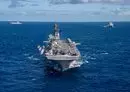
The US Marine Corps Amphibious Ready Group (ARG) and Marine Expeditionary Unit (MEU) serve as a forward-deployed crisis response force supporting national security objectives.
Together, they provide a highly flexible, self-contained force capable of responding to emergencies within hours or days of notification.
This sea-based capability allows the US to project power ashore without relying on host nation bases or large troop deployments.
The ARG MEU executes operations that advance US security interests and provides rapid response to crises around the globe.
Amphibious assault operations enable Marines to land forces from the sea to seize objectives, secure terrain, or support joint operations ashore.
Humanitarian assistance and disaster relief missions deliver food, medical aid, clean water, shelter, and engineering support following earthquakes, hurricanes, and floods.
These responses often require close coordination with host nations, nongovernmental organizations, and international relief agencies to stabilize disaster zones.
Crisis response missions include embassy reinforcement, evacuation of civilians, and limited security operations at US facilities during regional instability.
Noncombatant evacuation operations remain one of the most frequently tasked missions, requiring rapid extraction of US citizens and designated foreign nationals.
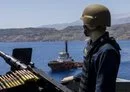
Maritime security operations focus on deterring piracy, protecting commercial shipping, and enforcing freedom of navigation across critical sea lines.
These missions routinely involve boarding operations, inspections, and interdiction of contraband that threatens regional stability.
Combat operations range from short-duration raids and reconnaissance missions to sustained operations supporting joint and combined forces.
In special operations roles, Marines work alongside US Special Operations Command on small unit raids and high-value target missions.
Partnerships and global reach
Strategic security cooperation strengthens alliances through joint training, military engagements, and combined exercises designed to improve regional partner capabilities.
Forward presence missions place ARG MEUs in the Mediterranean Sea, Red Sea, and Arabian Sea to deter aggression and reassure allied nations.
Routine surveillance patrols and bilateral training exercises reinforce the credibility of US commitments in strategically important maritime regions.
Expeditionary warfare capabilities allow the force to conduct sustained operations ashore with logistics, engineering, intelligence, and reconnaissance support.
Global readiness enables deployment within 24 to 48 hours for emergency missions requiring immediate military response.
Rapid mobility is achieved through amphibious ships, helicopters, and tiltrotor aircraft that insert and extract forces quickly over long distances.
Ship-to-shore flexibility allows commanders to shift seamlessly between maritime and land operations as battlefield conditions evolve.
Versatility and responsiveness
Interoperability with allied forces strengthens coalition effectiveness and ensures coordinated responses during multinational operations.
These capabilities make the ARG MEU one of the most versatile and responsive instruments of US military power, capable of addressing a wide range of missions from humanitarian assistance to combat operations.
Its unique combination of mobility, readiness, and adaptability allows the US to project power globally and respond to crises wherever they arise.