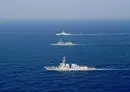
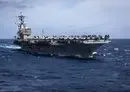
![The Nimitz-class aircraft carrier USS Nimitz (CVN 68) steams ahead of the Nimitz Carrier Strike Group during an integration exercise in the US Central Command area of responsibility on September 28, 2025. [US Navy photo]](/ssc/images/2025/12/15/53061-9410714-600_384.webp)
Maritime power projection defines how the US exerts influence far from its shores by moving capable military forces across contested oceans and vital chokepoints.
This approach deters conflict, safeguards trade routes, and supports stability across the world’s oceans.
It sustains deterrence, crisis response, and alliance commitments that rely on open and secure sea lanes.
Maritime power projection is the ability to use air, surface, and subsurface assets to shape outcomes in distant regions.
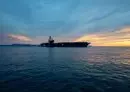
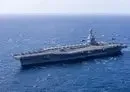
Aircraft carriers provide long-range strike capabilities and air supremacy, functioning as mobile airfields that are not dependent on foreign territory.
The US Navy operates 11 nuclear-powered carriers, giving it unmatched global aviation strength.
American submarines -- also nuclear powered -- offer endurance, speed, and stealth for intelligence gathering, deterrence patrols, and precision-strike missions worldwide.
Surface combatants, including destroyers and cruisers, deliver air and missile defense, sea control, and land attack, forming the backbone of maritime defense.
These ships rank among the most capable surface combatants globally.
Capabilities and global influence
Strategic presence places naval forces in critical regions to deter aggression, reassure partners and respond rapidly to crises in the Arabian Gulf.
Forward basing in locations like Bahrain shortens response times and sustains operations, while amphibious warfare enables the seizure of ports and terrain critical to access.
Sea denial and sea control seek to command or restrict movement through vital corridors such as the Strait of Hormuz and the Bab al-Mandab
Naval diplomacy uses port visits, multinational exercises and freedom of navigation operations to reinforce international law and demonstrate sustained commitment to allies.
Surveillance and reconnaissance rely on satellites, crewed aircraft, uncrewed systems, and undersea sensors to maintain continuous awareness across wide maritime areas.
Precision strike weapons including ship launched cruise missiles and emerging hypersonic systems extend the reach and speed of naval firepower against time sensitive targets.
Network centric operations connect sensors, shooters and commanders through resilient communications, while cyber forces protect friendly networks and seek to disrupt adversary decision making.
Economic power also underpins maritime influence by safeguarding sea lines that carry energy supplies, manufactured goods and food across the global trading system.
By integrating presence, technology, logistics, and alliances, the US employs maritime power projection to protect commerce, deter conflict, and sustain stability across the world’s oceans.