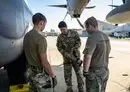
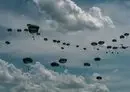
![US Army Paratroopers with the 82nd Airborne Division descend after exiting a C-130 aircraft, June 9, 2025. The mass tactical airborne insertion showcases rapid deployment capabilities and joint readiness. [US Army]](/ssc/images/2025/12/10/53021-_13j__xviii_airborne_corps-600_384.webp)
A global contingency corps
The US Army's XVIII Airborne Corps, known as the "Sky Dragons," is a cornerstone of America's rapid-reaction forces.
Including elite divisions such as the 82nd Airborne, 101st Airborne (Air Assault) and 10th Mountain, making it highly versatile for forced entry and expeditionary missions.
According to Army doctrine, the 82nd Airborne Division can deploy via parachute and establish a foothold in hostile environments within hours of notification.
Designed for global deployment on extremely short notice. Its rapid deployment mission has been refined over decades.
Air assault and light infantry capabilities allow adaptation to diverse operational scenarios worldwide.
The XVIII Airborne Corps regularly trains in large-scale exercises to maintain responsiveness.
In one recent war-fighter exercise, the corps simulated deploying across vast distances under a joint command structure, highlighting its global reaction capabilities.
The corps has also incorporated advanced command and control technologies, including systems that integrate communications across Army, Navy, Air Force and Marine networks.
Modern deployments and deterrence
In recent years, the corps has demonstrated its relevance in contemporary crises.
Elements of the XVIII Airborne Corps deployed to Eastern Europe in 2022 to reassure NATO allies following Russia's invasion of Ukraine, underscoring its deterrence role.
Similar deployments to the Middle East and Africa have reinforced America's ability to project power and stabilize volatile regions on short notice.
Historically, the corps demonstrated its agility during Operation Desert Shield in 1990.
Its initial elements began arriving in Saudi Arabia on August 8, securing forward positions during the coalition buildup.
During the Gulf War, the corps provided command and control to the 82nd Airborne, 101st Airborne and other formations, contributing heavily to coalition operations.
The XVIII Airborne Corps also supports joint and multinational missions that strengthen interoperability with allied forces across several regions.
Its headquarters frequently participates in combined planning events that integrate air, land and maritime components to ensure coordinated operations during crises.
These partnerships help the corps refine decision-making processes, improve joint logistics and strengthen the international networks required for rapid deployment in contested environments.
Future capabilities and modernization
The corps is investing in modernization initiatives that expand its role in multi-domain operations.
Integration of cyber, space and electronic warfare capabilities is reshaping how the corps prepares for contested environments.
Efforts like Joint All-Domain Command and Control enhance synchronization across services and domains, ensuring the corps remains agile and effective in future conflicts.
Central to US contingencies, its readiness enables operations in environments ranging from combat regions to humanitarian relief missions.
By maintaining light, agile, scalable forces, the XVIII Airborne Corps stands as a strategic enabler of US rapid-deployment capability across the globe.