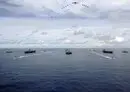
![To achieve peace through strength, the US synchronizes its Diplomatic, Information, Military and Economic (DIME) elements and heavily leverages CENTCOM's multi-domain operational architecture. USS Gerald R. Ford (CVN-78) returned to Naval Station Norfolk on May 16, 2026, following a historic 11-month deployment to the US 2nd, 4th, 5th and 6th Fleets. [US Navy]](/ssc/images/2026/06/09/56383-navy-600_384.webp)
American diplomats insist the vital Strait of Hormuz must remain an open waterway without any illegal tolls.
This fundamental requirement establishes a firm foundation for any discussions regarding a lasting deal with Iran.
To support these crucial talks, the US systematically aligns its diplomatic and economic efforts with robust military capabilities.
Supported by Gulf allies, US Central Command (CENTCOM) actively reinforces this diplomatic position through highly visible operational readiness.
This fully integrated strategy ensures that diplomats always operate from a position of undeniable and visible regional strength.
Integrating maritime and aerial operations
US Naval Forces Central Command (NAVCENT), and the 5th Fleet maintain a strong deterrent presence near the Strait.
Powerful carrier strike groups and guided-missile destroyers operate constantly within the strategic waters of the Arabian Gulf.
This formidable surface fleet works directly with US Air Forces Central (AFCENT), ensuring continuous aerial overwatch operations.
Unmanned aerial systems and specialized maritime patrol aircraft provide constant intelligence and surveillance across the entire maritime region.
This persistent monitoring allows military commanders to quickly detect and effectively address any Iranian destructive activities.
CENTCOM further enhances its traditional military posture by eagerly embracing advanced technology and fostering strong international coalition partnerships.
Furthermore, the US actively leads the Combined Maritime Forces (CMF), to project a unified international maritime resolve.
Pooling these naval assets demonstrates the deep trust shared between the US and its regional Gulf partners.
Fusing unmatched military capabilities with these strong alliances directly operationalizes the firm stance of US government negotiators.
This highly visible show of force provides American diplomats with a distinct upper hand during critical discussions.
Synchronizing these distinct elements of national power ensures negotiators pursue a favorable agreement without compromising core principles.
This resulting stability benefits all nations relying on the secure and free movement of global maritime commerce.