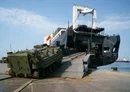
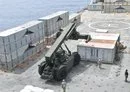
![An up-armored MK36 Medium Tactical Vehicle Replacement (MTVR) wrecker rolls off a Landing Craft Utility at Blount Island in Jacksonville, Florida, May 5, 2026, during ship-to-shore operations supporting the 22nd Marine Expeditionary Unit (Special Operations Capable) and CENTCOM readiness. [US Marine Corps]](/ssc/images/2026/05/22/56170-_139__blount_island_command_exercise-600_384.webp)
From the Arabian Gulf to the Red Sea, US military success depends on the ability to deliver combat power without relying on ports or fixed infrastructure.
Blount Island Command in Jacksonville, Florida, provides that capability by maintaining Marine Corps equipment in a ready-to-issue condition for rapid deployment worldwide.
As the Maritime Prepositioning Force hub, Blount Island Command gives US Central Command (CENTCOM) the mobility and logistical depth to respond rapidly to emerging crises.
By storing and maintaining combat equipment afloat and ashore, the command enables CENTCOM forces to project power into austere environments across the Middle East.
This capability reduces dependence on established deep-water ports that may be threatened by missile strikes, sabotage or regional instability.
It also strengthens the Department of War's ability to sustain distributed operations against anti-access and area-denial threats.
Validating contested logistics
The operational value of this concept was demonstrated on May 5 during a ship-to-shore offload conducted by Marines with the 22nd Marine Expeditionary Unit.
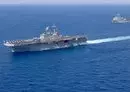
An up-armored MK36 Medium Tactical Vehicle Replacement wrecker rolled ashore from a Landing Craft Utility launched from the USS Fort Lauderdale (LPD-28).
The landing craft transited the St. Johns River and delivered the heavy vehicle directly onto a specially prepared sand ramp.
The exercise proved Marine forces can move critical equipment ashore without relying on traditional piers or established port facilities.
For CENTCOM, this capability is essential for operations along contested coastlines and unimproved shorelines throughout the Arabian Gulf and Red Sea.
Technology that expands operational reach
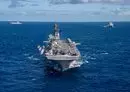
Blount Island Command supports the Maritime Prepositioning Force, which positions combat equipment near potential crisis zones around the world.
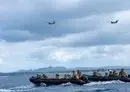
The Improved Navy Lighterage System enables at-sea assembly and selective over-the-beach delivery directly from ships operating offshore.
This seabasing approach allows CENTCOM commanders to establish resilient supply lines independent of fixed infrastructure.
Radio Frequency Identification technology, along with the Marine Corps Platform Integration Center, provides commanders with real-time visibility into equipment and supplies.
These tools track assets from ships in the Arabian Sea to forward operating bases across the theater.
By eliminating distribution bottlenecks, they allow forces arriving in theater to rapidly link with their equipment and achieve immediate combat readiness.
Blount Island Command's integration of mobility, seabasing and digital logistics ensures CENTCOM remains prepared to deter aggression and respond decisively throughout the Middle East.
Very wonderful
Reply