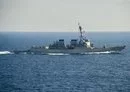
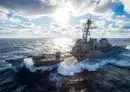
![The USS George H.W. Bush Carrier Strike Group conducts a simulated strait transit in the Atlantic Ocean, December 10, 2025. [US Navy]](/ssc/images/2026/03/03/54816-_77c__csg_10-600_384.webp)
Carrier Strike Group 10 fields a formidable surface force built around Arleigh Burke-class guided-missile destroyers.
Organized under Destroyer Squadron 22, the ships provide multi-mission capabilities central to strike group operations.
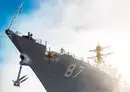
As of February 2026, assigned destroyers include USS Gonzalez (DDG-66), USS Ross (DDG-71), USS Donald Cook (DDG-75) and USS Mason (DDG-87).
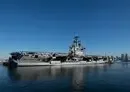
These ships operate alongside the aircraft carrier USS George H.W. Bush as part of an integrated naval formation.
Arleigh Burke destroyers form the surface core
The four destroyers represent both Flight I and Flight IIA variants of the Arleigh Burke class.
Flight I ships include USS Gonzalez and USS Ross, each displacing approximately 8,300 tons and measuring 505 feet long.
Flight IIA ships include USS Donald Cook and USS Mason, displacing about 9,200 tons and extending 509 feet in length.
Each destroyer carries a crew of roughly 300 sailors and officers and can operate independently or as part of the integrated strike group.
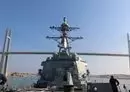
All four destroyers are equipped with the Aegis Combat System and AN/SPY-1D phased array radar.
This system enables detection, tracking and engagement of aircraft and cruise missiles at extended ranges.
Ballistic missile defense-capable ships can intercept short- to intermediate-range ballistic missiles using SM-3 interceptors.
In the anti-submarine role, destroyers use hull-mounted sonar and towed array systems to locate underwater threats.
Flight IIA ships embark MH-60R Seahawk helicopters for extended anti-submarine and surface warfare missions.
Surface warfare capabilities include Harpoon anti-ship missiles for engaging enemy vessels and the MK-45 five-inch gun for naval surface fire support missions.
The gun supports naval surface fire missions and can fire up to 20 rounds per minute.
Vertical launch system expands combat reach
Each destroyer carries the MK-41 Vertical Launch System, enabling rapid employment of multiple missile types across diverse mission sets.
Flight I ships field 90 launch cells, while Flight IIA variants carry 96 cells.
The system can deploy Standard Missiles, including SM-2, SM-3 and SM-6 variants, to counter aircraft, cruise missiles and ballistic threats.
Tomahawk Land Attack Cruise Missiles provide precision strike capability against land targets at ranges exceeding 1,000 miles.
RUM-139 Vertical Launch Anti-Submarine Rockets enable standoff engagements against submarine contacts at extended ranges while reducing risk to the host ship.
Additional defensive systems include two Phalanx Close-In Weapon System mounts that provide last-ditch terminal defense against incoming missiles and aircraft.
MK-32 triple torpedo tubes launch lightweight MK-46 or MK-54 torpedoes for close-range anti-submarine engagements and self-defense operations.
Flight IIA ships feature dual helicopter hangars supporting two MH-60R Seahawks armed with Hellfire missiles and MK-54 torpedoes.
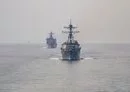
During a February 2026 Group Sail exercise, the destroyers integrated fully with USS George H.W. Bush.
The exercise included coordinated air defense drills, strait transit evolutions and underway replenishment operations.
The training validated readiness ahead of deployment following completion of Composite Training Unit Exercise requirements.
Together, the destroyers of Carrier Strike Group 10 provide layered defense, offensive reach and operational flexibility across global waters.