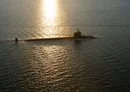
![Virginia-class fast-attack submarine USS Indiana returns to Joint Base Pearl Harbor-Hickam, January 29, 2026. Indiana is assigned to Submarine Squadron 7 and is capable of supporting various missions, including anti-submarine warfare, anti-surface ship warfare, strike warfare, special operations forces support and intelligence, surveillance and reconnaissance. [US Navy]](/ssc/images/2026/02/23/54659-_74d__virginia-class-600_384.webp)
The Virginia-class submarine is a nuclear-powered fast-attack submarine in service with the US Navy, designed for stealth and adaptability.
Introduced in 2004 with the commissioning of USS Virginia, the class integrates advanced sensors, modular payloads and special operations support into a single platform.
Developed after the Cold War, the class replaced the production of Seawolf-class boats, prioritizing affordability, versatility and rapid upgrades.
Its design reflects lessons learned from decades of submarine operations, emphasizing acoustics, precision strike and sustained global presence across contested waters.
Missions, weapons and special operations support
Virginia-class submarines conduct anti-submarine and anti-surface warfare, intelligence, surveillance and reconnaissance and long-range precision strikes.
They also support special operations forces with lockout chambers, swimmer delivery systems and reconfigurable spaces for equipment and mission kits.
Early blocks fielded 12 vertical launch tubes for Tomahawk land-attack missiles, integrated into the bow for rapid salvo fire.
Later blocks adopted Virginia Payload Tubes, maintaining Tomahawk capacity while simplifying maintenance and facilitating future payloads.
The class fires Mk 48 ADCAP torpedoes from four torpedo tubes, providing heavyweight lethality against submarines and surface ships.
A modular torpedo room can be reconfigured to carry gear for Navy SEALs, unmanned underwater vehicles or additional stowed weapons, depending on mission needs.
Mines can be deployed for area denial, adding a flexible option that complements traditional torpedoes and cruise missiles.
Block V boats introduce the Virginia Payload Module, significantly expanding strike capability with additional Tomahawk capacity.
Stealth, performance and evolving design blocks
A pump-jet propulsor reduces cavitation, lowering the acoustic signature compared with traditional propellers and improving stealth at higher speeds.
Extensive acoustic quieting, hull treatments and machinery isolation help evade detection by modern sonar systems, enhancing survivability in high-threat environments.
The class incorporates a large spherical bow sonar, wide-aperture arrays along the hull and towed arrays for long-range detection and tracking.
Electronic warfare suites and secure communications allow the submarine to sense, communicate and act while remaining covert in contested seas.
Typical Virginia-class boats measure approximately 115 meters in length, with a beam of about 10.4 meters.
Submerged speed is around 25 knots, supporting rapid repositioning and time-sensitive tasking while maintaining acoustic discretion.
Crews number roughly 130-135 personnel, including officers and enlisted sailors, depending on the block and configuration.
Blocks I through IV emphasize multi-mission flexibility and incremental improvements to sensors, combat systems and construction efficiency.
Block V adds the Virginia Payload Module, increasing Tomahawk capacity from 12 to 40 missiles and lengthening the hull to accommodate four large payload tubes.
Powered by a life-of-ship nuclear reactor, the class offers virtually unlimited range and endurance without mid-life refueling, enabling sustained global operations.
Designed for continuous modernization, Virginia-class submarines adopt modular architectures to implement upgrades throughout service life.
This approach preserves relevance against evolving threats, extending the platform's utility well into future decades of undersea warfare.
Very good.
Reply