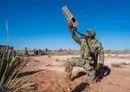
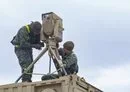
![A US Army sergeant demonstrates the proper form for employing a Dronebuster to counter drone threats at Eager Lion 2024 in Jordan, on May 13, 2024. [Sgt. Ivan Botts/US Army]](/ssc/images/2026/02/19/53678-dronebuster-600_384.webp)
The relatively low cost and high precision of unmanned aerial vehicles make them attractive to militaries and non-state actors worldwide, and their use is accelerating.
To keep pace, modern militaries need to leverage drones for their own combat and develop effective countermeasures.
The US military has committed to finding innovative solutions to manage the emerging threat of unmanned aerial systems (UAS).
Its new Dronebuster handheld counter-drone system promises to neutralize hostile drones before they can strike.
The system uses radio frequency (RF) jamming technology to disrupt communications between a drone and its operator.
Dronebuster disrupts UAS operations by targeting a drone’s control signals, GPS navigation, or live-feed video transmission.
This action forces the drone to either land, return to its point of origin, or lose control entirely.
These "soft-kill" methods also allow forces to capture adversary drones and collect information about the systems they use.
Unlike conventional counter-drone methods that rely on kinetic engagement, the use of RF jamming reduces the risk of collateral damage.
Non-kinetic approaches are particularly valuable in highly congested areas such as urban environments or near sensitive infrastructure where shooting down drones may be dangerous.
Force protection missions
Dronebuster can play a critical role in force protection missions, safeguarding military installations, deployed units or convoys from surveillance and attack by adversary drones.
Measuring at just under 56 cm and weighing only a few pounds, the system is compact and portable.
This design allows warfighters to carry and employ it easily, making it ideal for use by infantry units, security teams, and special operations forces.
The system was also designed for rapid deployment, requiring minimum training and ease of use even in high pressure environments.
It also can counter a broad array of commercial and military-grade drones, making it flexible enough to use across operational environments.
Training exercises feature Dronebuster
Dronebuster was used in key training exercises, notably the 2024 Eager Lion, a major multinational drill hosted by the US and Jordan.
Its use showcased the US’ growing counter-drone capabilities to several dozen participating nations.
As drone use proliferates, becoming increasingly accessible and sophisticated, nonlethal mechanisms to neutralize the threat become even more critical.
Dronebuster represents a step forward in the US military’s ability to protect its personnel and assets from drone reconnaissance, targeting, and direct strikes.
Its portability ensures a broad range of operational applications and the ability to extend this protection wherever US forces may need to go.